

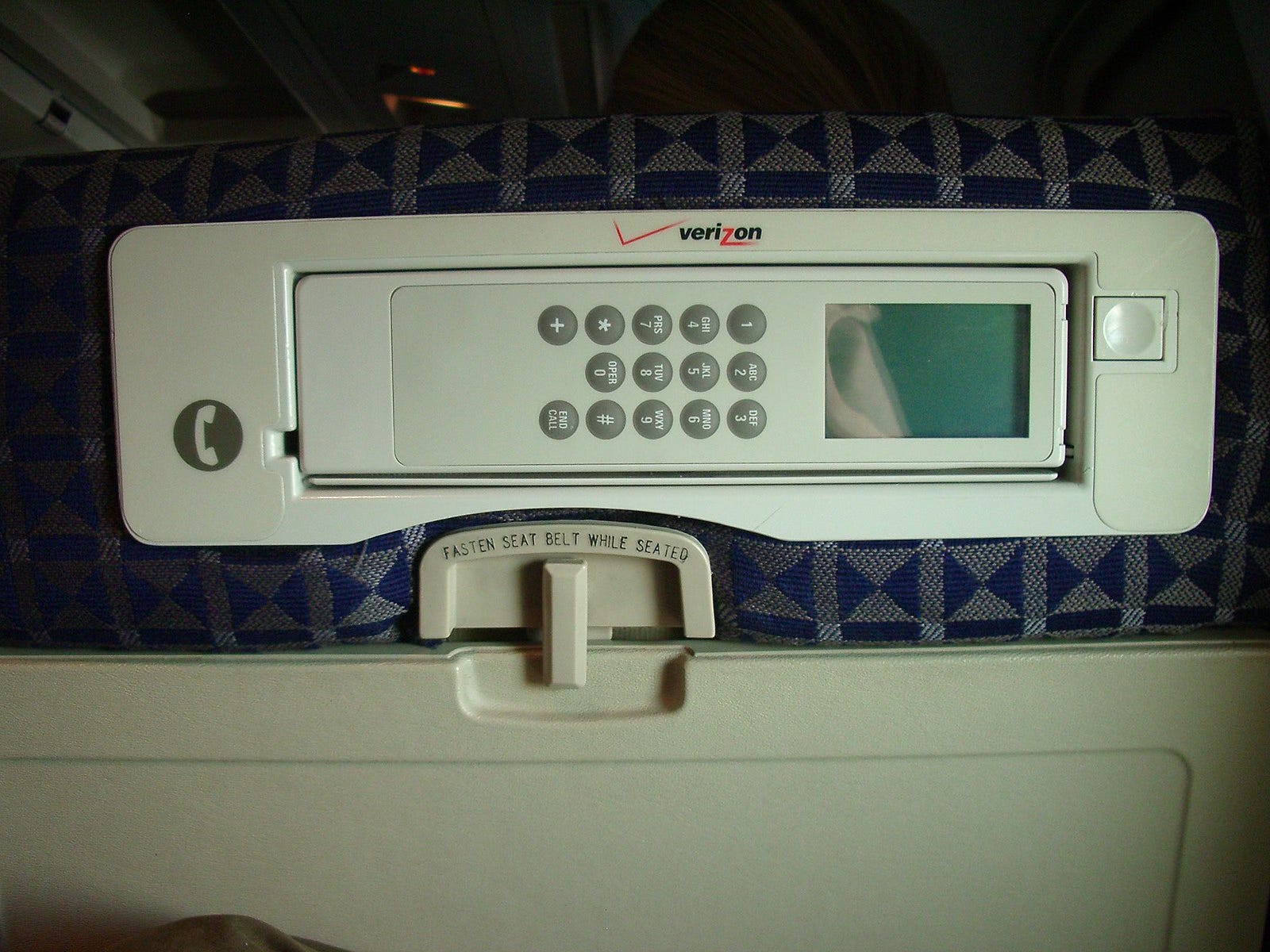
I plan to date myself on this Substack (a lot). For example, I have used an Airfone. I’ll admit it. Hell, I’ve used one more than once. It was a wonderful time to be alive!
Now, of course, the industry conversation has shifted to onboard internet. While the airline cabin was once a place of blissful disconnect from terrestrial obligations, the advent of onboard connectivity has made the plane no different than anywhere else you are expected to respond to a Microsoft Teams message, and that is, well, everywhere.¹
From a US-market perspective, the onboard internet story started with my friends² at Gogo. Gogo started as Aircell, who specialized in private aircraft communication. When Gogo was awarded the rights to Air-to-Ground (ATG) communication frequencies by the US FCC, it was game on! Gogo service started on American. Then they were on Delta. Then they were on Virgin America (RIP). Then they were on everybody (more or less). And in the matter of a few years, US airline passengers went from communication blackout to being upset if the internet was down.³ Airlines began to see wifi has a “must-have” onboard. In my world, we had to start dealing with potential inflight entertainment implications.
Gogo’s rapid success was definitely noticed within the airline supplier world. Their team suddenly had a big-ass booth⁴ at various industry trade shows. The company itself moved from suburban Itasca, IL, to a swanky new headquarters in downtown Chicago with much fancier office coffee machines and easy access to West Loop restaurants for much nicer supplier-hosted dinners.⁵

But, like any airline technology platform, Gogo’s success wasn’t guaranteed to last forever. Gogo’s ATG network quickly became crowded, famously underperforming on some key routes during busy times. Pricing was still very high, unpredictable, and a source of passenger complaint.
The airline supplier game can best become compared to a game of leapfrog, and Gogo was about to get jumped from way above. From space, even . . .
Satellite-based internet solutions were already in development when Gogo launched, but their profile was still relatively small. However, things changed significantly when Viasat entered the market on JetBlue in 2014. The Viasat service was faster, more reliable, and free!⁶ It was free thanks to a partnership between my friends at JetBlue and a small start-up called Amazon. Not too long after that debut, Gogo’s original launch customer American decided it would also be moving to Viasat. Delta jumped on after that, and so on and so on. It’s a tough business.

As a result, Gogo’s booth at the trade shows got a lot smaller, and Visasat’s booth took over as the new exhibit hall behemoth. Other major industry players like Panasonic rolled out significant satellite service upgrades on global airline customers. Soon you, the airline passenger, no longer had the excuse of being over an ocean to keep you from reviewing that Powerpoint deck. (Boo.)
But even if you’re Viasat, there’s always something else coming. We’ll talk more about the new hotness (and how to pay for it) in our next edition.
Notes
I always chuckle at out-of-office replies that say “I will not have access to email” — yes you will, so just say you’re not going to answer it
When I use the term friends on this blog, I do mean actual friends — I spent a lot of time with the team at Gogo (and Jetblue and American . . . you’ll get the idea)
The easiest way to dominate at a panel conversation at an industry conference in the early 2010’s was to show this Louis CK clip
I used to run conference booths at one of my jobs and “big-ass” is the official exhibition term, go figure
I spent time in both Gogo buildings, and while the downtown one was cool, it was much easier to swing by Lou Malnati’s on your way to ORD from the Itasca location — long live the suburbs
Contrary to the marketing and PR machine in Atlanta, JetBlue had free wifi long before the rest of the US industry
One of my acquaintances, a CEO of a major food and dining establishment, maintains that the internet has never worked on any flight he has taken . . . that’s big-brain stuff people